Double Drop D tuning lowers both outside E strings to D.
Low to high: D A D G B D
The four middle strings stay in standard tuning. The new low D gives you the same bass power-chord layout as Drop D, while the high D can ring above chords as a drone. That top-string change is also the part most likely to catch out a player using familiar shapes.
How to tune to Double Drop D
Start in standard tuning, E A D G B E.
- Lower string 6 from E2 to D2.
- Leave strings 5, 4, 3 and 2 unchanged.
- Lower string 1 from E4 to D4.
- Confirm every string with a chromatic tuner.
Useful ear checks:
- The 12th-fret harmonic on string 6 should match the open fourth string. Both sound D3.
- The open first string should match the 12th-fret harmonic on string 4. Both sound D4.
| String | Standard | Double Drop D | Movement |
|---|---|---|---|
| 6 | E2 | D2 | Down one whole step |
| 5 | A2 | A2 | No change |
| 4 | D3 | D3 | No change |
| 3 | G3 | G3 | No change |
| 2 | B3 | B3 | No change |
| 1 | E4 | D4 | Down one whole step |
Both moved strings will feel slightly looser. Tune down slowly, use a tuner for the final pitch, and raise only those two strings when returning to standard.
What transfers—and what changes?
Shapes that use only strings 2–5 keep the same pitches as standard tuning. Shapes that include either outside string need checking:
- String 6 now sounds two semitones lower.
- String 1 now sounds two semitones lower.
- An open first string is D, which can be a chord tone, a suspension or a colour note depending on the chord.
The right question is not “Does this standard shape still look the same?” It is “What notes does the shape produce now?”
Accurate Double Drop D chords
Fingerings run from the sixth string to the first. x means mute and 0 means open.
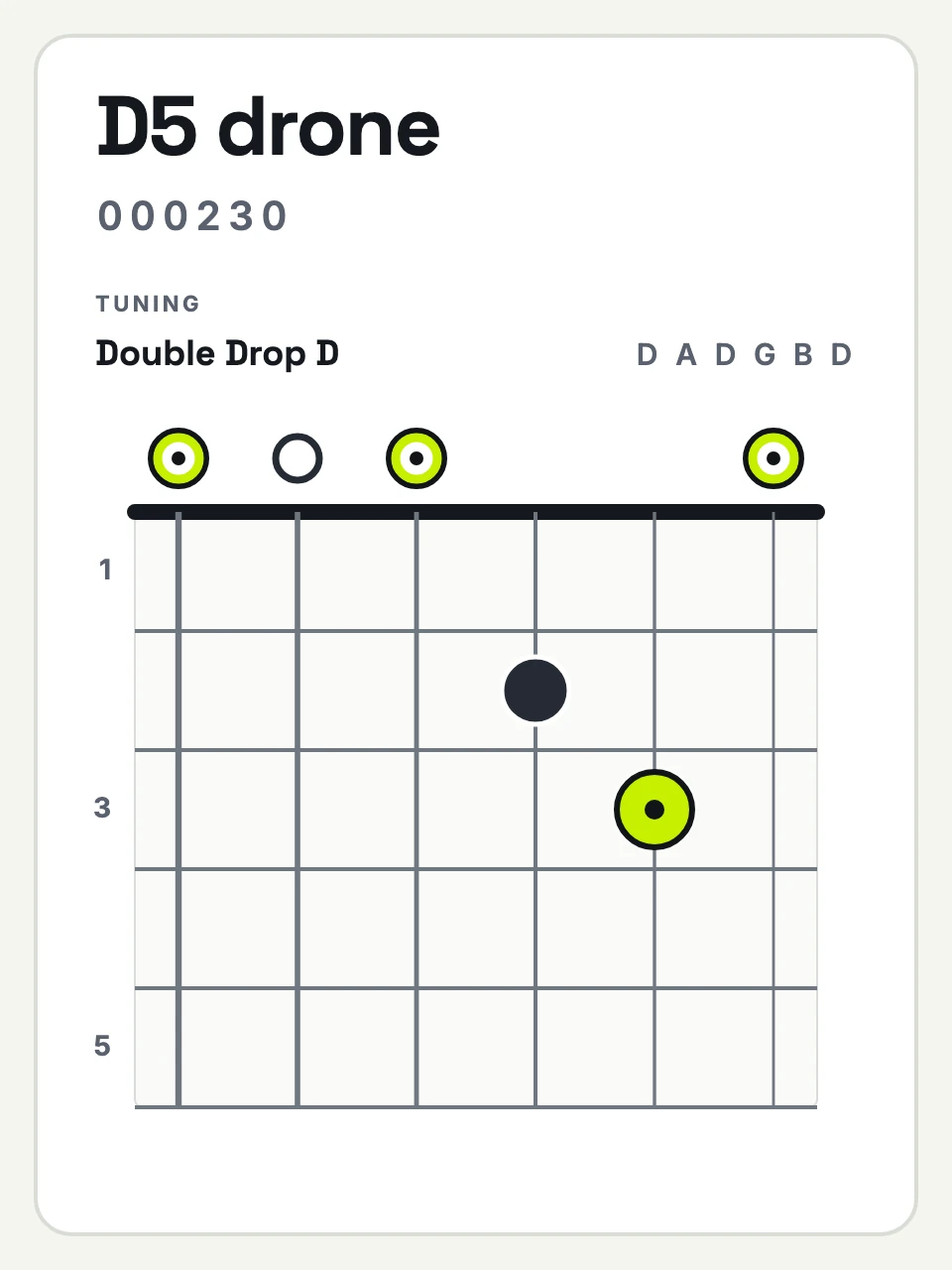
0 0 0 2 3 0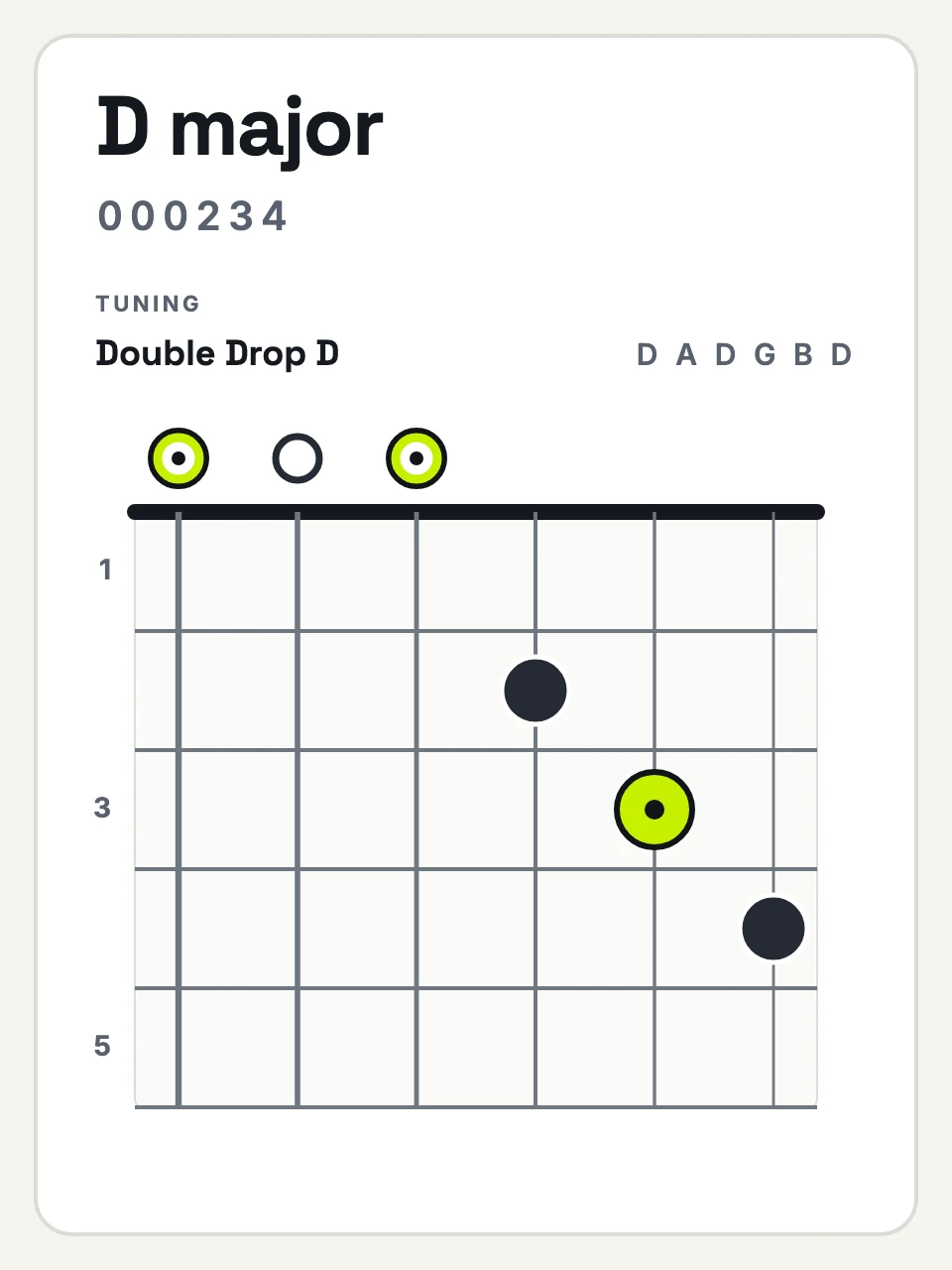
0 0 0 2 3 4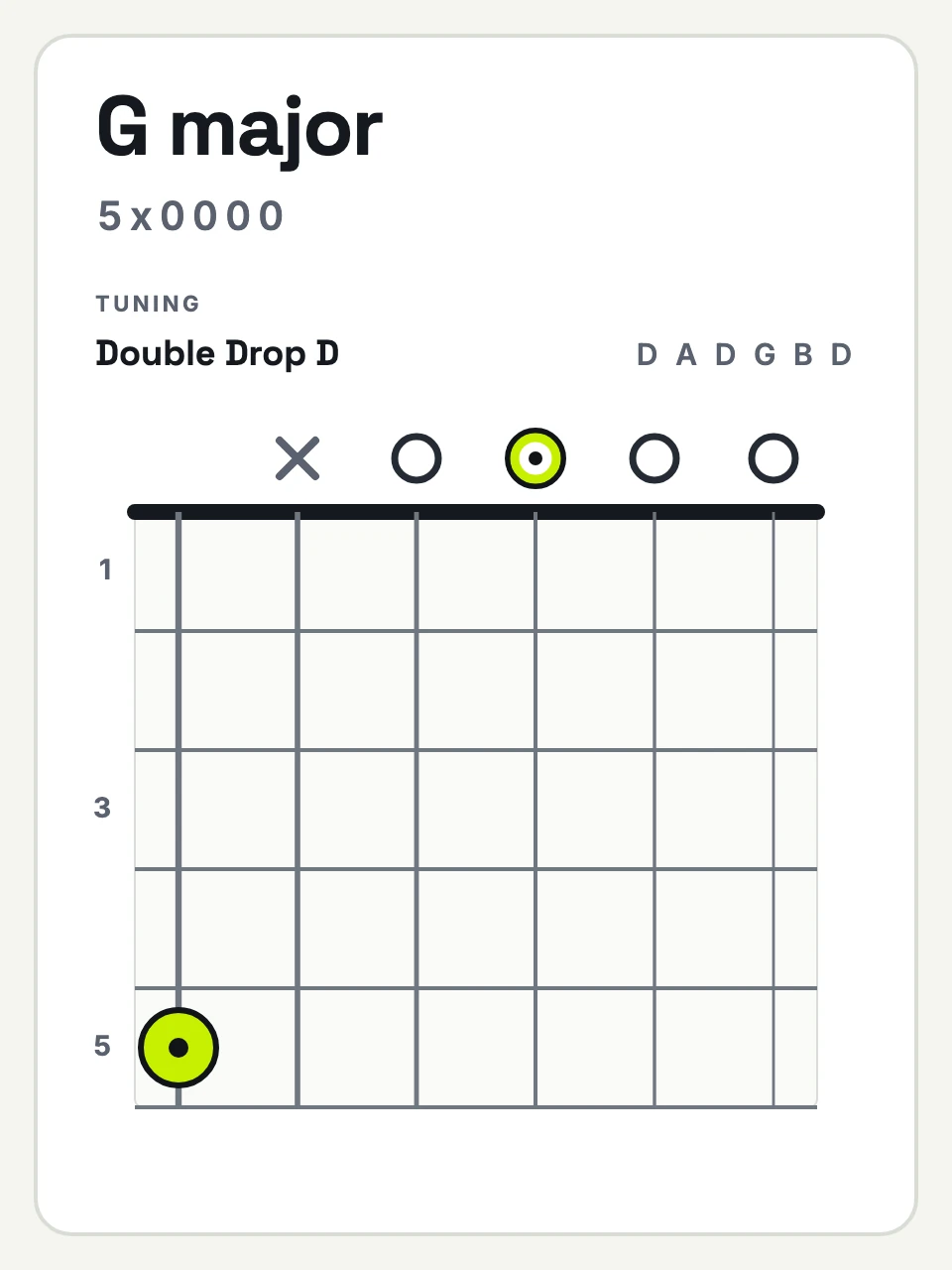
5 x 0 0 0 0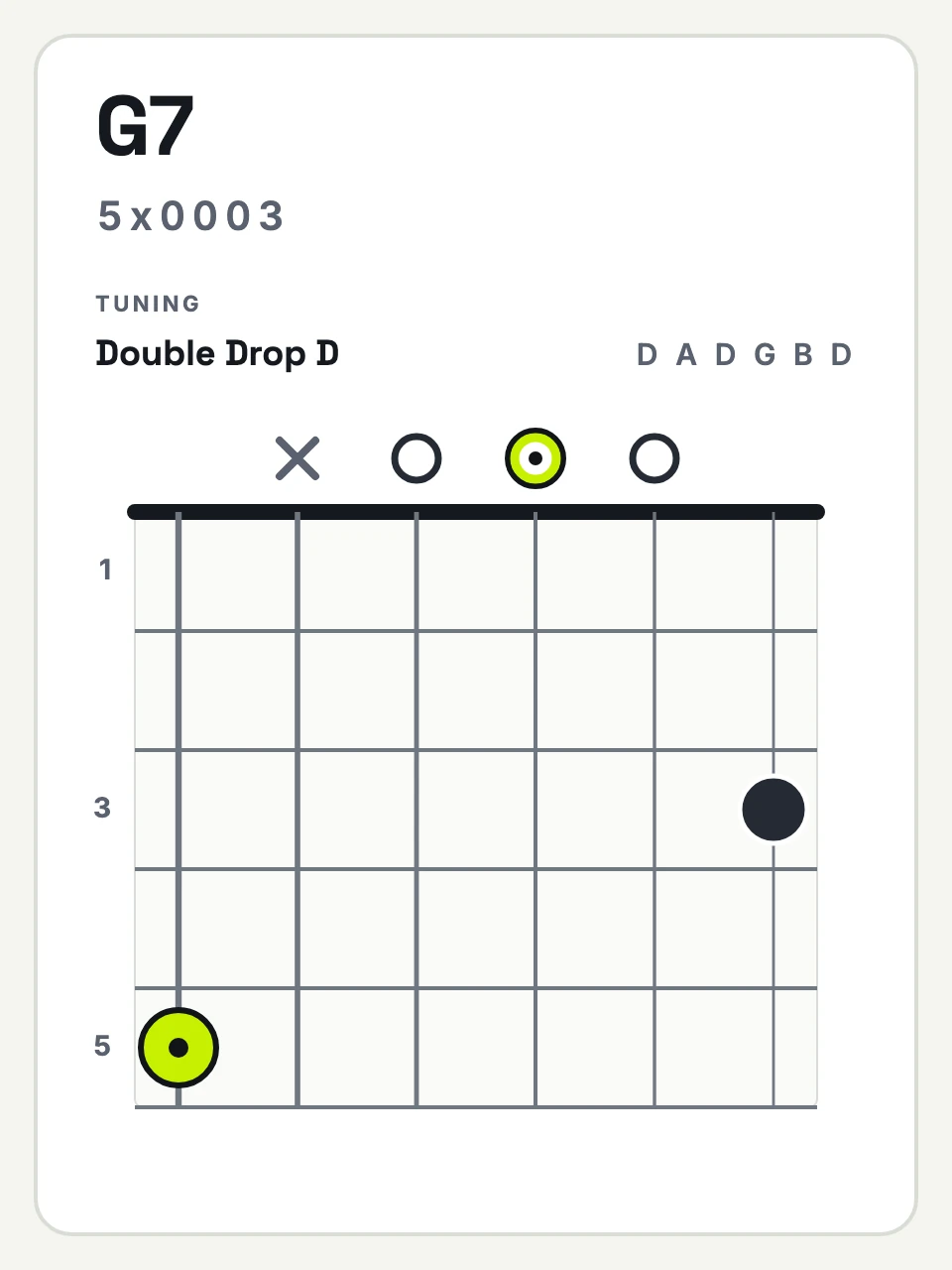
5 x 0 0 0 3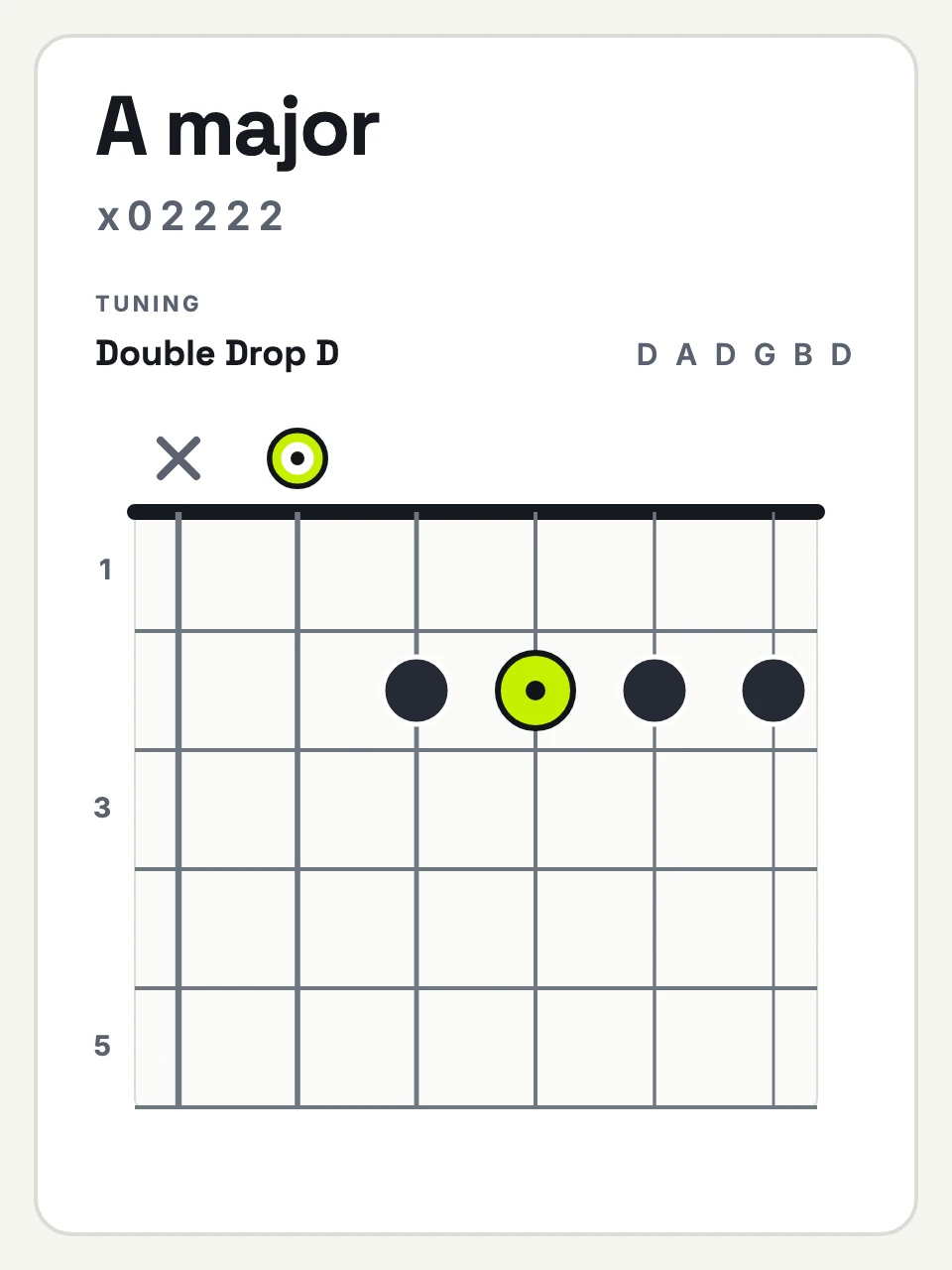
x 0 2 2 2 2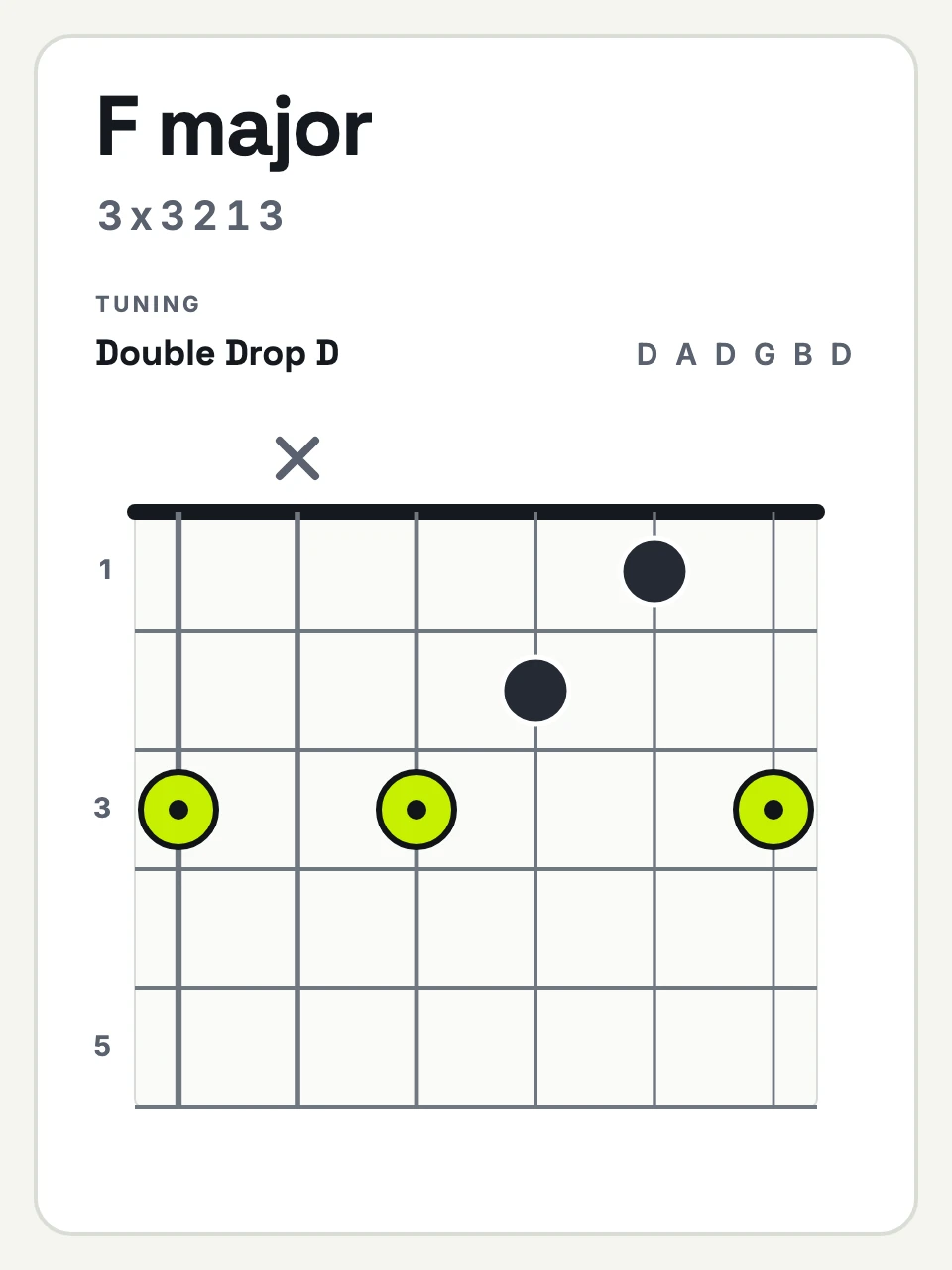
3 x 3 2 1 3| Chord | Fingering | Notes present | Important detail |
|---|---|---|---|
| D5 drone | 0 0 0 2 3 0 | D A | There is no F#, so this wide D–A–D–A–D–D voicing is neutral, not D major. |
| D major | 0 0 0 2 3 4 | D A F# | Fret the high D string at 4 to add F#, the major third. |
| G major | 5 x 0 0 0 0 | G D B | The open first string is D, the fifth of G. |
| G7 | 5 x 0 0 0 3 | G D B F | Fret 3 on the high D string to add F natural and create G7. |
| A major | x 0 2 2 2 2 | A E C# | Fret the high string at 2; leaving it open adds D and produces Asus4. |
| F major | 3 x 3 2 1 3 | F A C | Fret the high string at 3 for F; leaving it open adds D and makes F6. |
These labels correct a common problem with Double Drop D charts: a shape can look familiar while its open first string changes the harmony.
How to play a G chord in Double Drop D
Use 5 x 0 0 0 0 for G major.
- String 6, fret 5: G
- String 4, open: D
- String 3, open: G
- String 2, open: B
- String 1, open: D
Mute string 5 if you want a clearer voicing. If you fret the first string at 3, the note becomes F and the chord becomes G7. That single-note comparison is a useful way to hear what the changed top string is doing.
A first Double Drop D progression
Play one bar each of:
D5 0 0 0 2 3 0 → G 5 x 0 0 0 0 → F 3 x 3 2 1 3 → G 5 x 0 0 0 0
This is an original practice loop, not a transcription. Let the outside D strings ring only when they belong to the named chord. On F major, fret the first string at 3; an open first string would change the voicing to F6.
On the second pass, change G major to G7 by moving only the first string from open to fret 3. The contrast makes the tuning’s main harmonic feature audible.
Is “Ballad of Hollis Brown” in Double Drop D?
Yes. A widely used Dylan transcription lists D A D G B D—both E strings down one whole step—and capo 1 for the referenced recording. This page explains the tuning; it does not reproduce the song’s copyrighted lyrics or tablature. See the Dylanchords tuning note for that song-specific transcription.
Double Drop D versus Drop D
| Drop D | Double Drop D | |
|---|---|---|
| Notes | D A D G B E | D A D G B D |
| Strings changed | 6 only | 6 and 1 |
| Top-string standard shapes | Unchanged | Must be checked |
| Main advantage | Low-D power chords with familiar treble layout | Low and high D drones around the chord |
If you want the lower bass note without changing your top-string chord and melody shapes, start with Drop D. Move to Double Drop D when the high D drone is part of the sound you want.
Frequently asked questions
Is Double Drop D an open tuning?
The six open strings contain D, A, G and B. They do not form a complete plain D-major triad because F# is missing and G and B are present. It is better described as a partial or modal-style tuning built around D drones than as a full open-D-major tuning.
Why does my normal D chord sound different?
In standard tuning, the first string at fret 2 is F#. In Double Drop D, fret 2 on the first string is E. Use fret 4 when you need F# in that position, or deliberately use the open D for a neutral D5 drone.
How do I return to standard tuning?
Raise strings 6 and 1 from D back to E, then check all six strings with a tuner.