Drop D tuning is standard tuning with one change: lower the sixth string from E to D.
Low to high: D A D G B E
That single change gives you a deeper bass D and a movable one-finger power-chord shape on the lowest three strings. It also means you can keep much of what you already know: strings 1–5 have exactly the same notes as standard tuning.
How to tune to Drop D
Start in standard tuning, E A D G B E.
- Play the open sixth string.
- Lower it slowly from E to D—one whole step, or two semitones.
- Leave strings 5, 4, 3, 2 and 1 unchanged.
- Confirm the result with a chromatic tuner.
For an ear check, the 12th-fret harmonic on the lowered sixth string should match the open fourth string. Both sound D3. A tuner is still the safer final check.
| String | Standard | Drop D | Movement |
|---|---|---|---|
| 6 | E2 | D2 | Down one whole step |
| 5 | A2 | A2 | No change |
| 4 | D3 | D3 | No change |
| 3 | G3 | G3 | No change |
| 2 | B3 | B3 | No change |
| 1 | E4 | E4 | No change |
The lowered string may feel looser than usual. That is normal. If it rattles badly, check your tuning first; persistent buzz can be a setup issue rather than a rule of Drop D.
What changes from standard tuning?
The useful shortcut is simple:
- Any shape that uses only strings 1–5 keeps the same pitches.
- Any shape that includes the sixth string needs attention, because that string now sounds two frets lower.
- On strings 6–4, the same fret now produces a root–fifth–octave power chord.
This is why a standard five-string A major still works, but a six-string E minor needs a new bass fingering. The old sixth-string note is not “wrong”; it is simply a different note and can change the chord name.
Explore Drop D chord voicings
Start with D power chords, then choose another root or chord type.
Five useful Drop D chords
Fingerings below run from the sixth string to the first. x means mute the string and 0 means play it open.
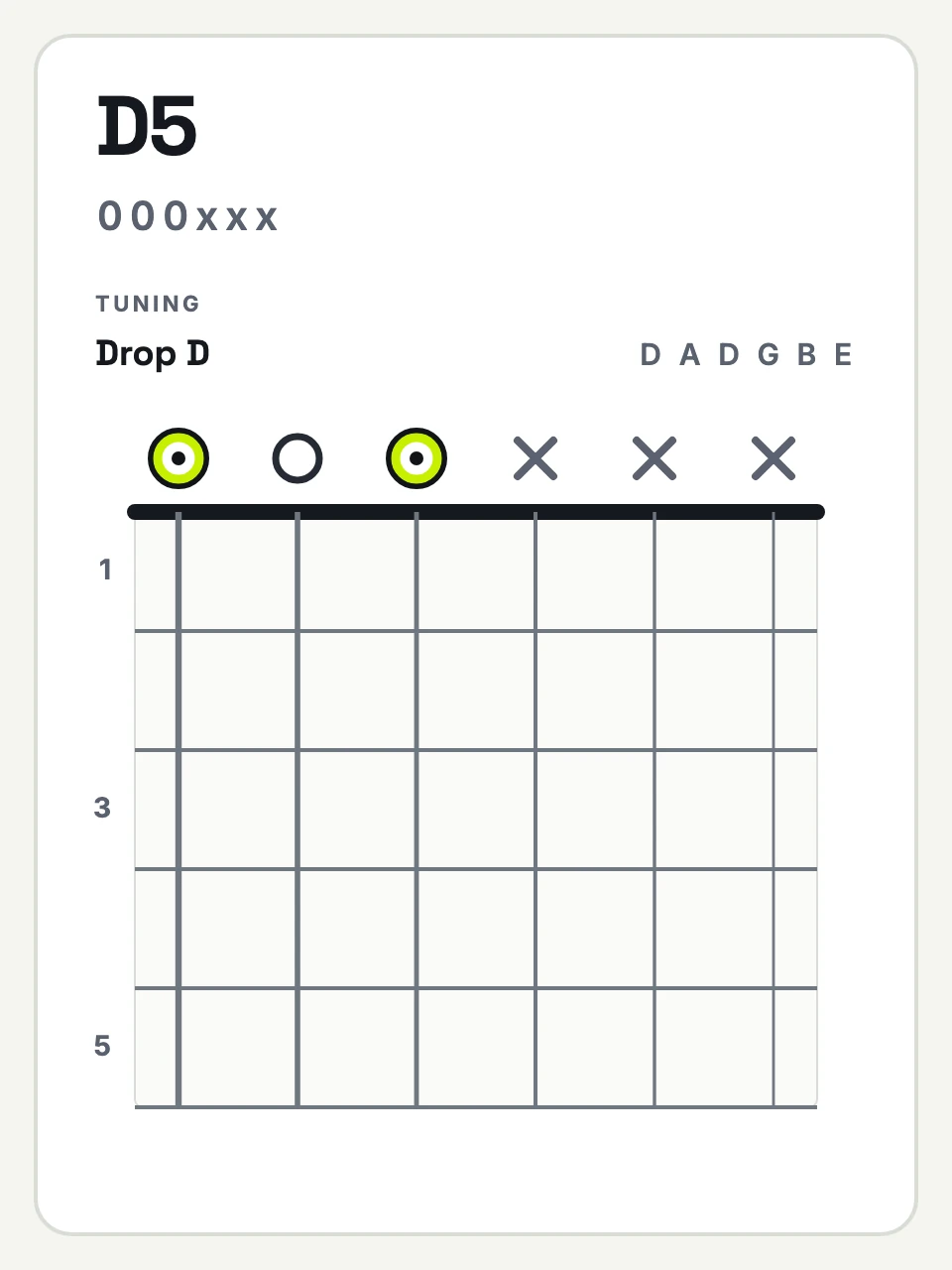
0 0 0 x x x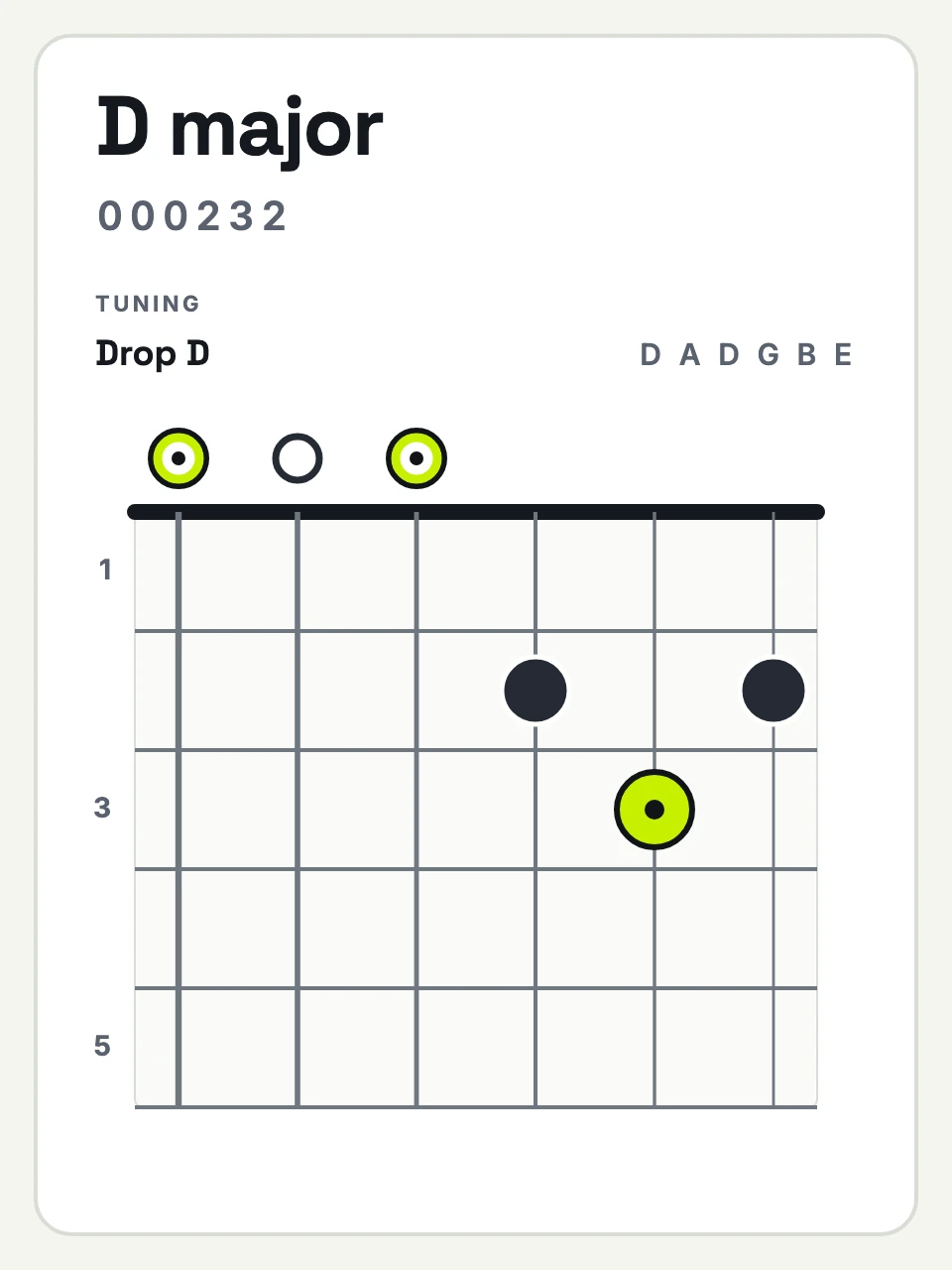
0 0 0 2 3 2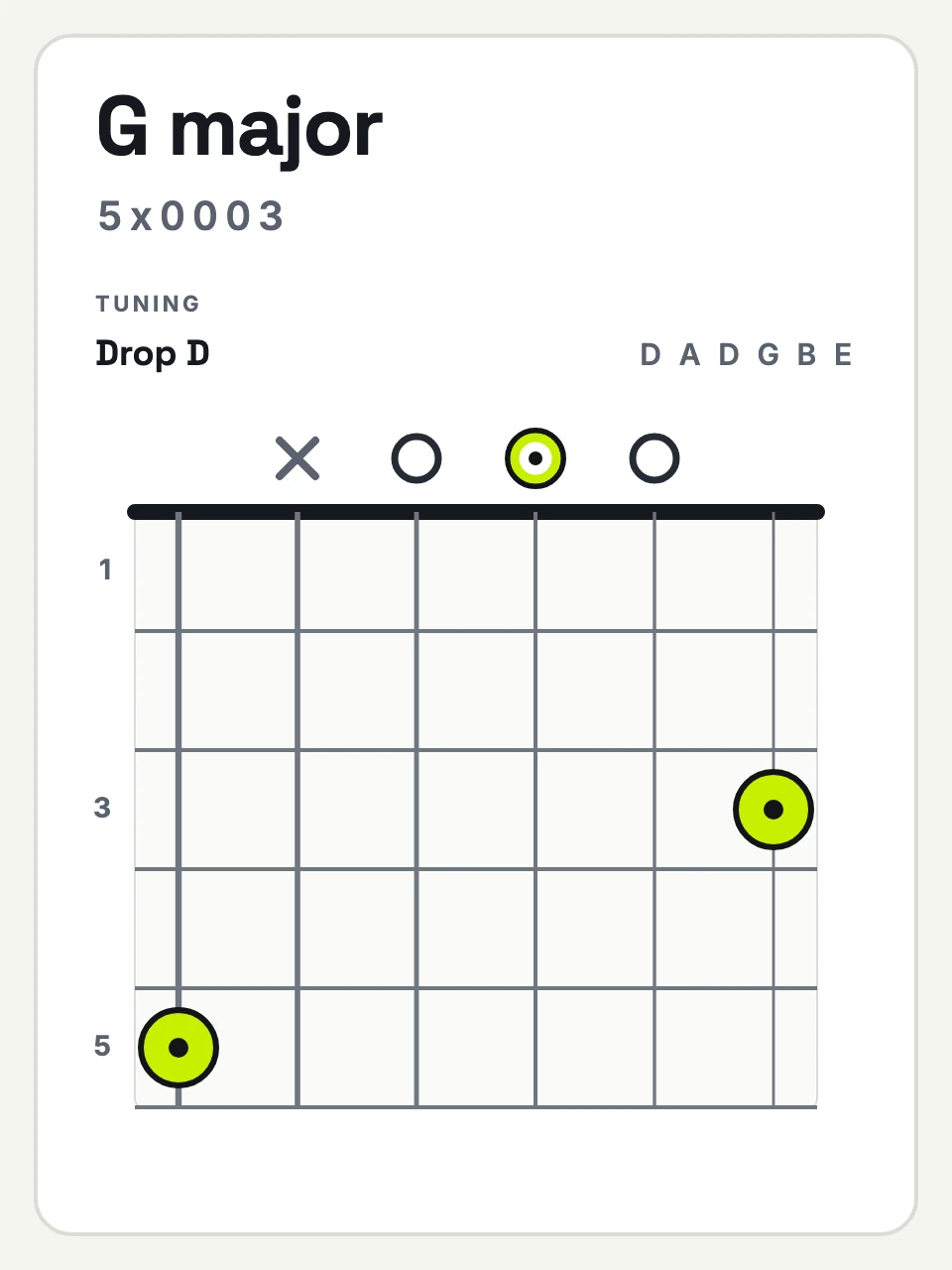
5 x 0 0 0 3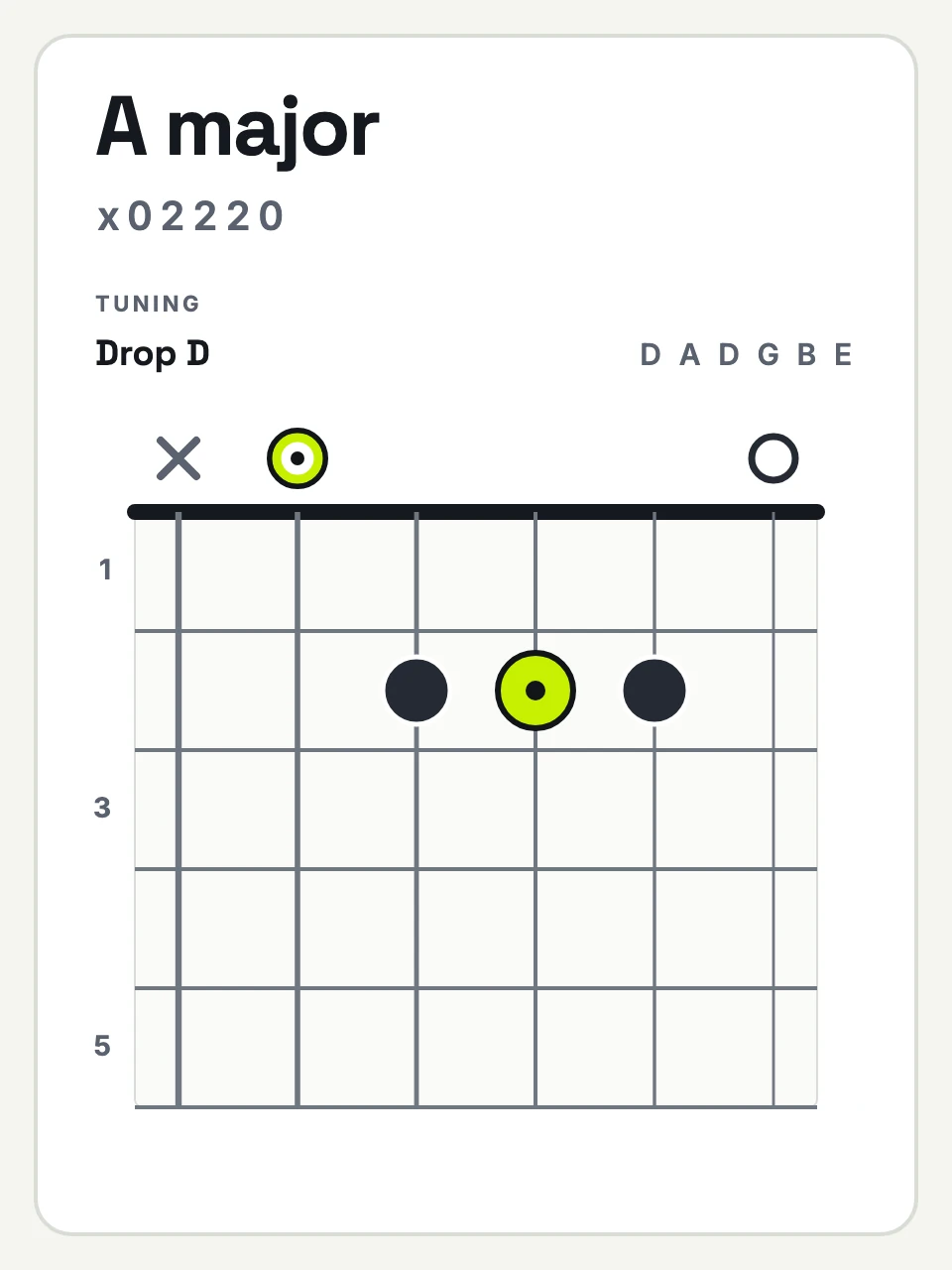
x 0 2 2 2 0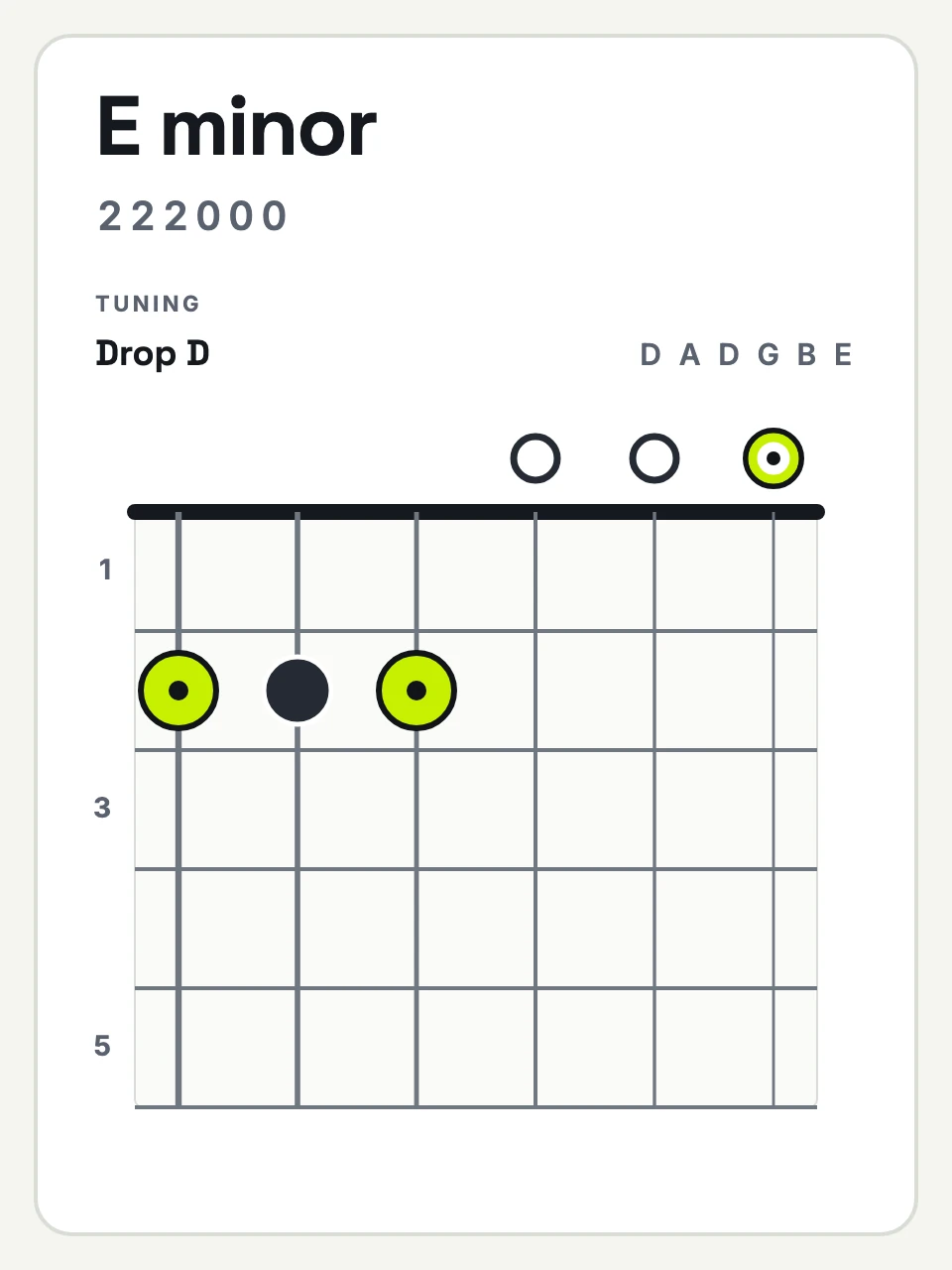
2 2 2 0 0 0| Chord | Fingering | Notes present | Why it works |
|---|---|---|---|
| D5 | 0 0 0 x x x | D A | The open bass strings give D–A–D. There is no third, so it is neither major nor minor. |
| D major | 0 0 0 2 3 2 | D A F# | The familiar open-D treble shape sits above the open D–A–D bass. |
| G major | 5 x 0 0 0 3 | G D B | Fret the lowered sixth string at 5 for G and keep the familiar open treble notes. |
| A major | x 0 2 2 2 0 | A E C# | The standard five-string A shape transfers unchanged when string 6 is omitted. |
| E minor | 2 2 2 0 0 0 | E B G | Fret the three bass strings at 2 to restore E–B–E below the open treble strings. |
The one-finger Drop D power-chord map
Bar the same fret across strings 6, 5 and 4. Those strings are tuned D–A–D, so the shape always gives a root, fifth and octave.
| Fret | Power chord | Bass notes |
|---|---|---|
| 0 | D5 | D A D |
| 3 | F5 | F C F |
| 5 | G5 | G D G |
| 7 | A5 | A E A |
| 10 | C5 | C G C |
| 12 | D5 | D A D |
Try this original four-bar exercise: play 0 0 0, 3 3 3, 5 5 5, 7 7 7, then return to open. Mute the higher strings and concentrate on making each three-string barre sound clean.
Drop D scales: what actually changes?
Scale shapes on strings 1–5 are unchanged from standard tuning. Only the sixth-string notes move.
For D minor pentatonic, the notes are D, F, G, A and C. On the lowered sixth string they appear at:
0 — 3 — 5 — 7 — 10 — 12
That is D–F–G–A–C–D. Use the open low D as a pedal tone, then answer it with familiar D minor pentatonic phrases on strings 1–5.
This distinction matters: there is no mysterious separate “Drop D scale.” The scale’s notes stay the same; the fretboard location of notes on string 6 changes.
A first Drop D progression
Play one bar each of:
D major 0 0 0 2 3 2 → G major 5 x 0 0 0 3 → A major x 0 2 2 2 0 → G major 5 x 0 0 0 3
Let the open fourth string ring where it stays inside the chord. Then repeat the progression with only the lowest three strings as D5–G5–A5–G5. The contrast shows the difference between full triads and power chords immediately.
Drop D versus Double Drop D
Drop D changes only the sixth string. Double Drop D also lowers the first string from E to D.
Choose Drop D when you want the low-D power-chord layout while keeping standard-tuning melody shapes on the top five strings. Choose Double Drop D when you want D drones on both outside strings and are willing to adjust familiar shapes that use the first string.
Frequently asked questions
Is Drop D the same as D standard?
No. Drop D is D A D G B E; only string 6 changes. D standard lowers every string one whole step to D G C F A D.
Can I use normal chords in Drop D?
Yes. Shapes confined to strings 1–5 keep their standard-tuning notes. Shapes using string 6 need a changed fingering, a muted sixth string, or a deliberate new bass note.
Why are Drop D power chords easier?
The lowest three strings form D–A–D. At any one fret, that relationship remains root–fifth–octave, so one finger can fret all three notes.
How do I return to standard tuning?
Raise only the sixth string from D back to E and confirm all six strings with a tuner.